Engineering Basics
Introduction
In any sort of robotics or engineering, many basic concepts involving physics, math, and other engineering principles need to be applied in order to ensure structural integrity and ensure the robot can fulfill the tasks in mind. Hence, this section will cover the basic concepts to consider during the building process.
Core Motor Mechanics
When it comes to the attachments on a robot, it is important to consider these main mechanics to ensure it is up for the task by having enough power.
Torque vs. Speed
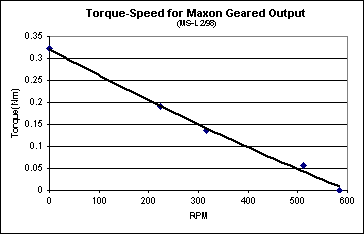
The balance between torque and speed is one of the most key factors to consider when designing the robot, whether it be the drivetrain, or the attachments. Speed is how fast something can move, while torque is the pushing or pulling power it has. The two are inversely proportional which means that to increase torque, speed must be sacrificed and to increase speed, torque is reduced. A motor however, will have a set rpm(rotations per minute) that it uses, so often times it isn’t preferable to attach a wheel or another attachment directly to the motor axel, instead using contraptions like gear ratios(next section) that will be able to convert the motor power onto another axle that is directly attached to the contraption, while the gears themselves can vary in order change speed or torque.
Gear Ratios
In order to change the torque and speed, we can use gear ratios to change the effort of the motor’s power. Gears are one of the ways to transfer the rotational force of a motor spinning onto another axel, such as one attached to the wheels on the robot or onto another attachment. We can also control the force so we aren’t spinning along at the motor’s set rate of rotations per minute, but instead able to increase/decrease either speed or torque as needed.

Power Transmission
These are methods of transferring the power the motor generates through rotation, and converting it into power for an attachment or the drivetrain. These can include gears, belts, or chains that allow for power transference and conversion to other systems. In the diagram shown, the gear labeled “Drive” is the one that is directly attached to the motor.
Types of output mechanisms: By utilizing the power of the motors, different mechanisms on a robot can transfer this power into application, such as picking up cubes or driving across the field. Mechanisms include drivetrains(to allow for movement and turning), claws(for grabbing items), and elevator systems(to lift things).
Robot Stability
When making a robot, it is important to consider stability as a factor and ensure that it is well balanced and able to remain stable, despite movement by either the drivetrain or by attachments on the robot. Not having proper robot stability can lead to the robot leaning when moving or possibly tipping over when trying to move certain parts.
Center of Gravity
The center of gravity is the point where the robot’s mass is concentrated, basically the spot where the robot experiences the force of gravity. Having a center of gravity that is low, or close to the ground, tends to increase stability and prevent the robot from tipping. Placing the heaviest components like the motor or battery as low as possible will help to increase stability. This is also important to note because lifting arms or lifts tends to make a robot unstable unless it has a solid center of gravity.
Weight Distribution
Weight distribution refers to how mass is spread across the robot’s frame. Even weight distribution helps ensure that all wheels maintain proper contact with the ground, which improves control and reduces strain on individual components. Uneven distribution can cause one side of the robot to carry more load, leading to drifting, wheel slippage, or poor turning performance. Designers should aim to balance weight both front-to-back and side-to-side whenever possible.
Friction and Traction
Friction between the wheels and the ground is what allows a robot to move without slipping. Traction depends on factors such as wheel material, tread pattern, surface type, and the normal force acting on the wheels. Insufficient traction can cause the robot to slide or lose control, while excessive traction can increase stress on motors and drivetrain components. Choosing appropriate wheels and maintaining consistent weight on all drive wheels is key to stable motion.
Why Robots Drift
Robots may drift due to uneven friction, unbalanced weight distribution, or differences in motor performance. Even small variations in motor speed or wheel diameter can cause a robot to veer to one side over time. Drift can also occur if the robot’s center of gravity is not centered or if one side has more traction than the other. Proper calibration, symmetrical design, and software compensation can help reduce drifting behavior.
Build Quality
When building a robot, keeping certain ideas and concepts in mind can ensure that designs remain more structurally optimal for any task a robot may need to complete.
Bracing
Bracing strengthens the robot’s structure by preventing parts from flexing or bending under load. Adding cross-braces, gussets, or triangular supports can significantly improve rigidity without adding much weight. Good bracing is especially important in areas that experience repeated stress, such as the drivetrain, arm mounts, or lift mechanisms. A well-braced robot performs more consistently and is less likely to fail during operation.
Reducing Wobbling
Wobbling is often caused by loose joints, unsupported shafts, or long structural members without reinforcement. To reduce wobble, builders should ensure that components are securely fastened and supported on multiple sides when possible. Using bearings instead of friction-based supports, tightening tolerances, and shortening unsupported spans can all improve stability. Reducing wobble leads to more accurate motion and better control.
Precision vs. Strength
There is often a trade-off between precision and strength in robot design. Highly precise components allow for accurate movement and alignment but may be more fragile, while stronger components can handle greater loads but may sacrifice fine control. A good design balances both by reinforcing critical load-bearing areas while maintaining precise alignment where accuracy is required. The best solution depends on the robot’s intended task and operating environment.
How to Prototype
Prototyping is an essential part of the engineering and building process, as it allows designers to test ideas before committing to a final build. Instead of directly constructing a finished robot or mechanism, engineers create simpler versions to evaluate whether a design functions as intended. This helps identify issues related to strength, motion, stability, or feasibility early on, when changes are easier and less costly to make.
When prototyping, it is generally best to start with basic materials and simple designs. Cardboard, wood, 3D-printed parts, or spare metal components can be used to quickly assemble test mechanisms. At this stage, appearance and precision are less important than functionality. The goal is to determine whether an idea works, not whether it is optimized.
Effective prototypes usually focus on testing one main concept at a time, such as a lifting mechanism, drivetrain layout, or joint design. Testing multiple ideas at once can make it difficult to determine what caused a problem or improvement. After testing, observations should be made about what worked well and what failed, allowing the design to be refined.
Prototyping is an iterative process, meaning designs are tested, adjusted, and tested again. Through repeated prototyping, engineers can improve reliability, reduce structural weaknesses, and ensure that the final robot performs consistently under real conditions.